

Most couples walk into a first session because the small stuff stopped resolving itself. The same disagreement keeps resurfacing in a slightly different costume. A parent and teenager have started talking past each other instead of to each other. Something has gone quiet that used to be louder, and that quiet often turns out to be the real warning sign, well before anyone calls it a crisis.
That gap between “this is hard” and “we should get help” is where a lot of people get stuck. Couples and family therapy still carries a reputation as a last resort, something you try after the relationship is already in trouble. The people who actually benefit most tend to reach out earlier, while there is still enough goodwill in the room to work with. Knowing what to look for, and what therapy can realistically do, makes that decision easier.
The Signs Are Usually Patterns, Not Single Events
A single argument rarely sends anyone looking for a therapist. The pattern underneath it does: the same fight on a loop, the same shutdown whenever a hard topic comes up, the same feeling of being unheard no matter how the conversation is phrased. Couples often recognize it as conflict that escalates faster than it resolves, a slow drift toward parallel lives, or one partner consistently withdrawing while the other pursues. In families, the pattern tends to show up differently: communication breakdowns between parents and kids, tension after a major change such as divorce, relocation, or a new diagnosis, or one member’s struggle with mental health, substance use, or behavior reshaping how everyone else relates to each other.
These signs point to a relationship that has hit a problem the people inside it cannot fully see, simply because they are too close to it. That has little to do with how much anyone loves or tries. It reflects the limit of what two or three or five people can untangle on their own, especially when everyone is responding to the same stress from a different angle.
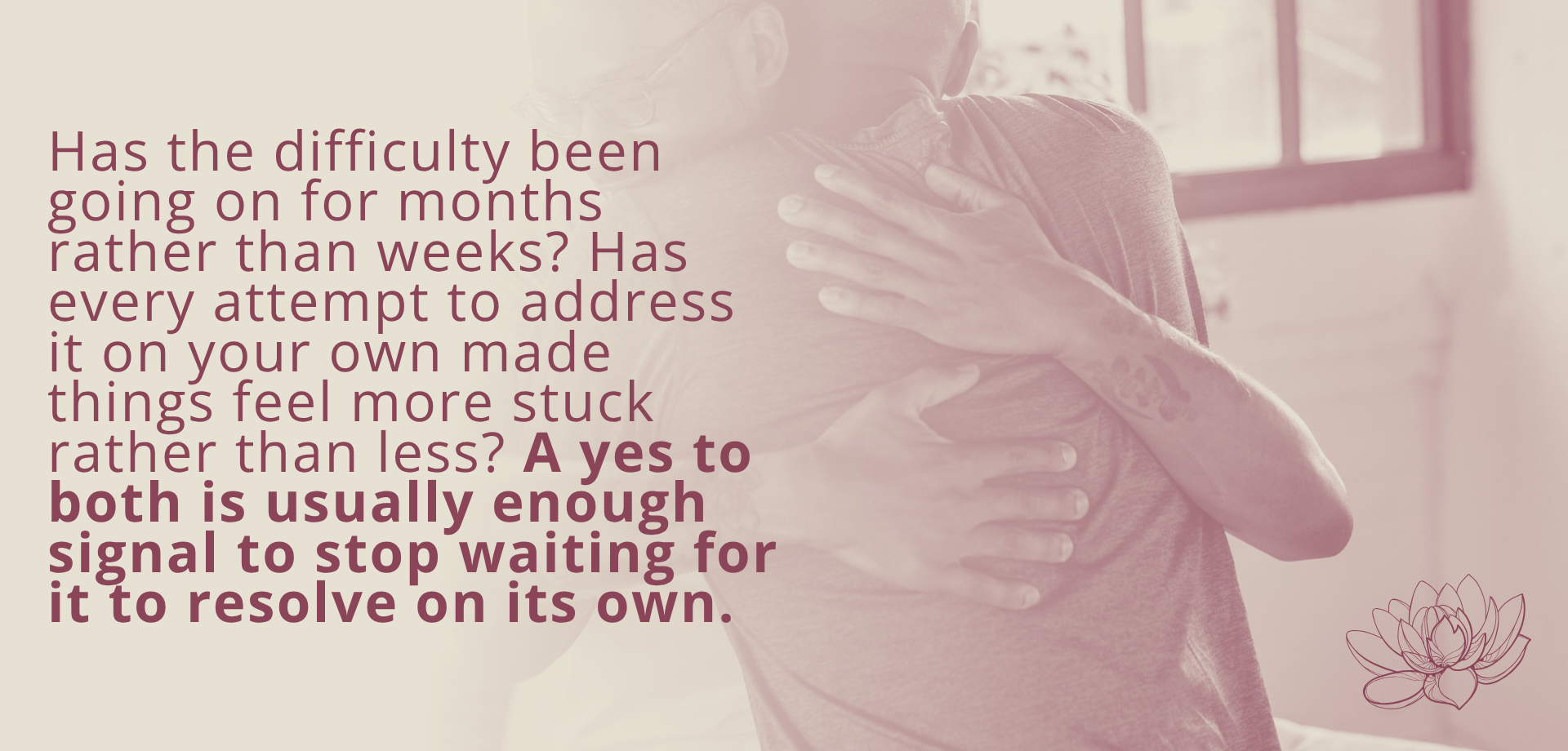
A useful, if imperfect, test is duration and direction. Has the difficulty been going on for months rather than weeks? Has every attempt to address it on your own made things feel more stuck rather than less? A yes to both is usually enough signal to stop waiting for it to resolve on its own.
What Couples and Family Sessions Actually Look Like
A common misconception is that a therapist will sit between two (or more) people and referee who is right. Sessions tend to start somewhere quieter than that, with each person describing what they are experiencing rather than cataloguing what the other person is doing wrong. A therapist trained in emotionally focused therapy is listening for the underlying emotional cycle: the moment one partner reaches for connection and gets met with distance, or the moment a teenager’s anger is actually a stand-in for feeling unseen.
In the early sessions, the work is mostly diagnostic, similar in spirit to what happens in any first counselling appointment. The therapist maps the cycle, figuring out what triggers it, how each person reacts, and what keeps it repeating. This stage can feel slow, particularly for people who came in wanting a quick fix, but skipping it tends to produce surface-level changes that do not hold. Once the pattern is named out loud, in a room where both people can hear it without immediately defending themselves, something shifts. Couples often describe this as the first time they have actually felt understood rather than just spoken at.
Family sessions follow a similar arc, though the composition can flex depending on what is needed. Some weeks bring in the whole household; others call for one-on-one time with a parent or a single child, woven into the broader treatment plan. A skilled family therapist adjusts who is in the room according to what will move the work forward in that particular stretch of treatment.
What Therapy Can Realistically Achieve
It helps to be specific about outcomes, because vague promises of “better communication” do not mean much to someone deciding whether to invest the time and money. In couples work, realistic goals include breaking a recurring conflict cycle, rebuilding a sense of safety after a betrayal or major rupture, and learning to repair after an argument instead of letting it fester for days. Some couples are working toward reconciliation. Others are working toward a clearer, calmer process for separating, especially when children are involved and co-parenting will continue long after the relationship does not.
In family work, the goals often center on restoring a functional level of communication between generations, helping a family adjust to a major life transition without the adjustment fracturing relationships, and giving everyone, including the quietest member of the household, a structured way to be heard. Families dealing with addiction or a member’s mental health crisis often work toward a different kind of goal: learning how the rest of the family can respond in ways that genuinely help, instead of accidentally reinforcing the problem. This work also tends to run shorter than people expect. Data from the American Association for Marriage and Family Therapy shows that couples and family therapy typically requires fewer sessions on average than individual treatment, a detail worth holding onto for anyone picturing an open-ended commitment.
This unfolds over a series of months, with early sessions focused on understanding the pattern and later sessions focused on practicing new ways of responding to it, ideally outside of the therapy room as well as inside it. A 2019 meta-analysis published in the Journal of Marital and Family Therapy reviewed 33 randomized controlled trials and found that emotionally focused couples therapy produced a meaningfully larger improvement in relationship satisfaction than behavioral approaches immediately after treatment. The research is also honest about a harder truth: those gains are easier to sustain in the months right after treatment than a full year out, which is part of why practicing new patterns between sessions matters as much as the sessions themselves.
When One Partner or Family Member Is Reluctant
It is common for one person to want therapy more than the others. A partner who feels desperate for change may be met with a partner who feels blamed by the suggestion itself, and a parent who wants the family in counselling may be met with a teenager who refuses to say a word in the room. This reluctance calls for direct acknowledgment rather than a workaround.
A good first move is reframing the invitation. “We need to fix you” and “we need to fix this relationship” tend to put people on the defensive. “I want a space where we can both be heard, including you” tends to land better. For families, sometimes the most productive starting point is an initial session with just the parents, or just the adult who initiated the process, with the explicit goal of building enough of a plan that the rest of the family can be invited in without feeling ambushed.
If a partner or family member remains unwilling to attend, individual counselling is still a legitimate, useful path. It works differently than couples or family sessions, shifting how one person shows up inside the dynamic rather than addressing the dynamic directly, which sometimes moves the whole system more than people expect. This is especially true in relationships shaped by patterns like codependency, where one partner’s needs have quietly taken a back seat for a long time; individual work can rebuild the footing needed to eventually bring both people into the room together.
Deciding Whether Now Is the Right Time
There is rarely a perfect moment to start. Most people wait longer than they should, partly because the cost of starting feels more immediate than the cost of waiting. The relationships that tend to do best in therapy share one trait: at least one person was willing to ask for outside help before contempt or hopelessness had fully set in.
If the patterns described here sound familiar, whether between partners or across a family, that recognition is worth sitting with rather than brushing past. At Jadestone Counselling, sessions start with genuine curiosity about your specific situation, not a generic script. A free consultation is simply a conversation to see whether that approach feels like a good fit for you, with no pressure to commit to anything beyond it. If you're ready to talk it through, booking that first conversation is a small, low-stakes step toward getting unstuck.